05:30
Dawn
Pink haze over the harbour. The towers stand like sentinels in half-light — only the navigation beacons and the Bank of China crown are visible. Junk boats drift across the calm water in silence.
Best forPhotography · joggers
A vertical megalopolis whose spires rise above the clouds. More than 1,500 buildings over 100 metres on just 1,114.57 km² make it one of the densest urban skylines on Earth — and Hong Kong surpassed 100 completed buildings of 200 metres or taller in 2025, joining Dubai, Shenzhen and New York among the four cities to have crossed that threshold by the end of 2025.
Source: Council on Vertical Urbanism (CVU; formerly CTBUH) · 2026 Trends & Forecasts. Population: Hong Kong Census and Statistics Department. Land area: Hong Kong Lands Department.
Reference date: end of 2025
An editorial portrait of Hong Kong from dawn to night — five observations of the harbour at different times of day, shaped for the reader's imagination rather than as documentary record.
Pink haze over the harbour. The towers stand like sentinels in half-light — only the navigation beacons and the Bank of China crown are visible. Junk boats drift across the calm water in silence.
The vertical city in full light. The spires disappear into a low summer cloud; below them the harbour traffic is at its busiest. Every tower reveals its full geometry — the prismatic mass of the BoC, the wedge of 2IFC, the diamond of Central Plaza.
The sun sets behind Lantau and the glass facades turn to copper and gold. The ICC begins to glow. From the Avenue of Stars you can watch the entire harbour switch from warm light to neon in twenty minutes.
A coordinated display across multiple buildings on both sides of the harbour begins at 8 pm nightly. From the Tsim Sha Tsui waterfront, the skyline transforms into a sound-and-light performance scored for radio broadcast.
A thunderstorm gathering over the harbour. The tallest spires become pure silhouettes against the weather front. Hong Kong at its most cinematic.
Hong Kong is one of two Special Administrative Regions of China and a former British colony, returned to the mainland in 1997 after 156 years of imperial rule. Packed into a narrow strip of land between mountains and the South China Sea, it concentrates one of the world's densest clusters of high-rise buildings.
Across Central and Kowloon, the concentration of tall buildings is among the highest of any major metropolis. This is a city that doesn't spread — it climbs. Above the harbour the vertical city has become one of the most recognisable urban silhouettes on Earth.
Under the framework of "one country, two systems", Hong Kong keeps its own legal system, currency and a court system inherited from English common law — a legacy of 156 years of British rule and the compromise on which the region's entire architectural and economic model rests.
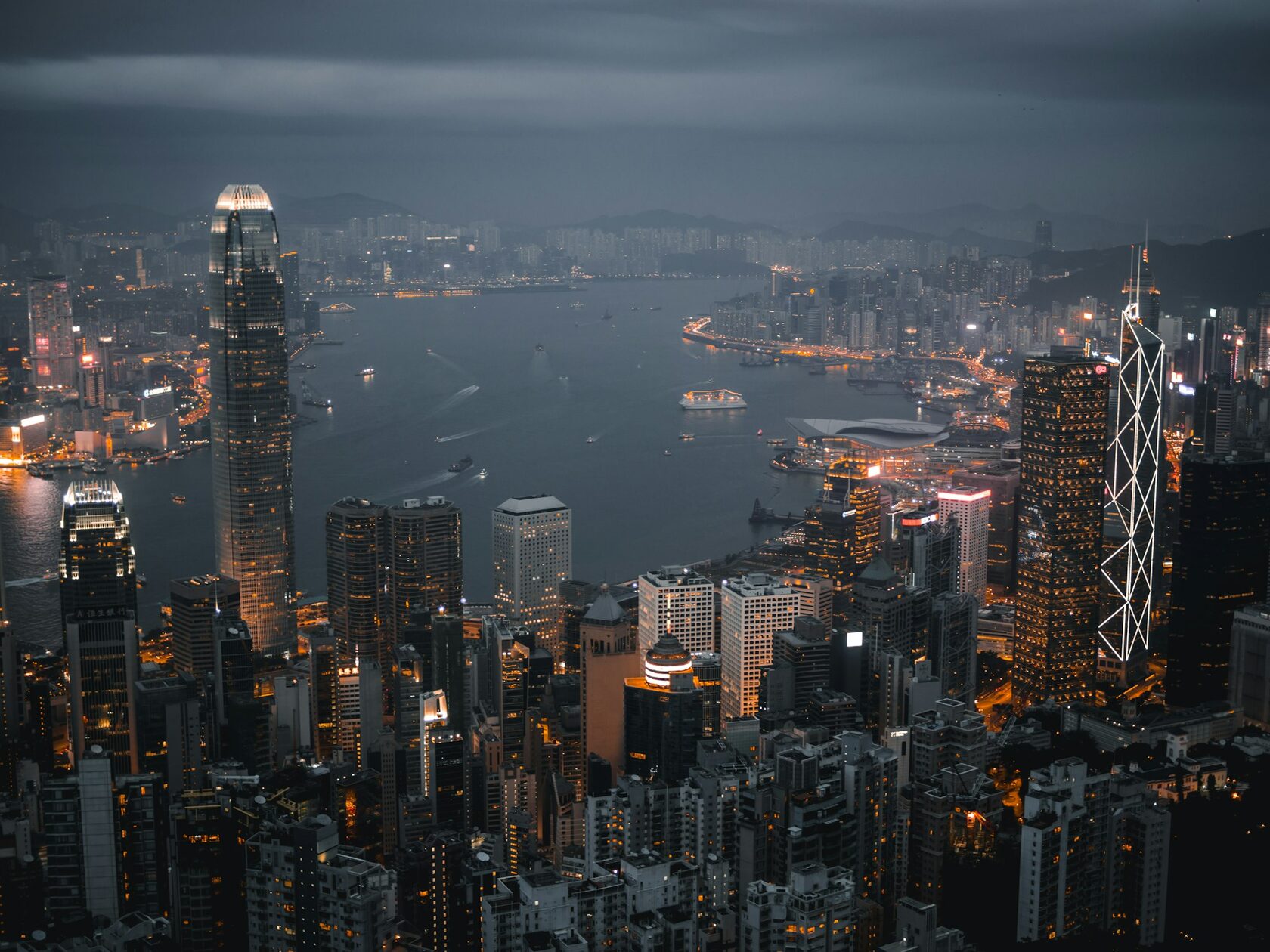
A city where buildings over 100 m are part of everyday life — not a tourist attraction.
Source: Council on Vertical Urbanism (CVU; formerly CTBUH) · 2026 Trends & Forecasts — Hong Kong crossed 100 completed towers above 200 m in 2025, joining Dubai, Shenzhen and New York among the four cities to reach that threshold by the end of 2025.
Reference date: end of 2025
Three urban zones reveal different chapters of Hong Kong's vertical development. They are an editorial selection, not an official administrative division.
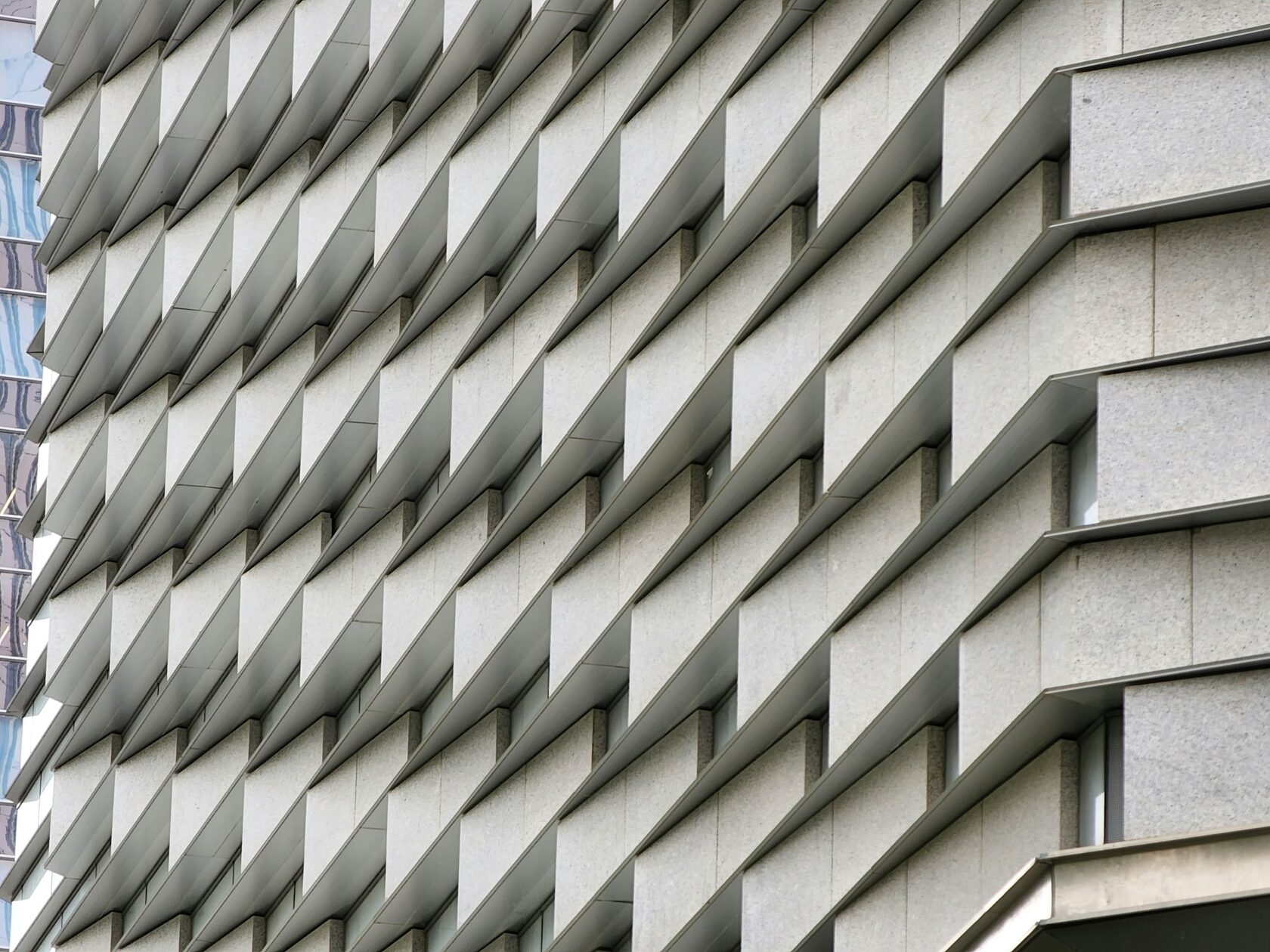
Asia's financial core
Hong Kong's verticality began here in 1841. Today the Central district is one of the world's leading concentrations of headquarters of major global banks and financial institutions.
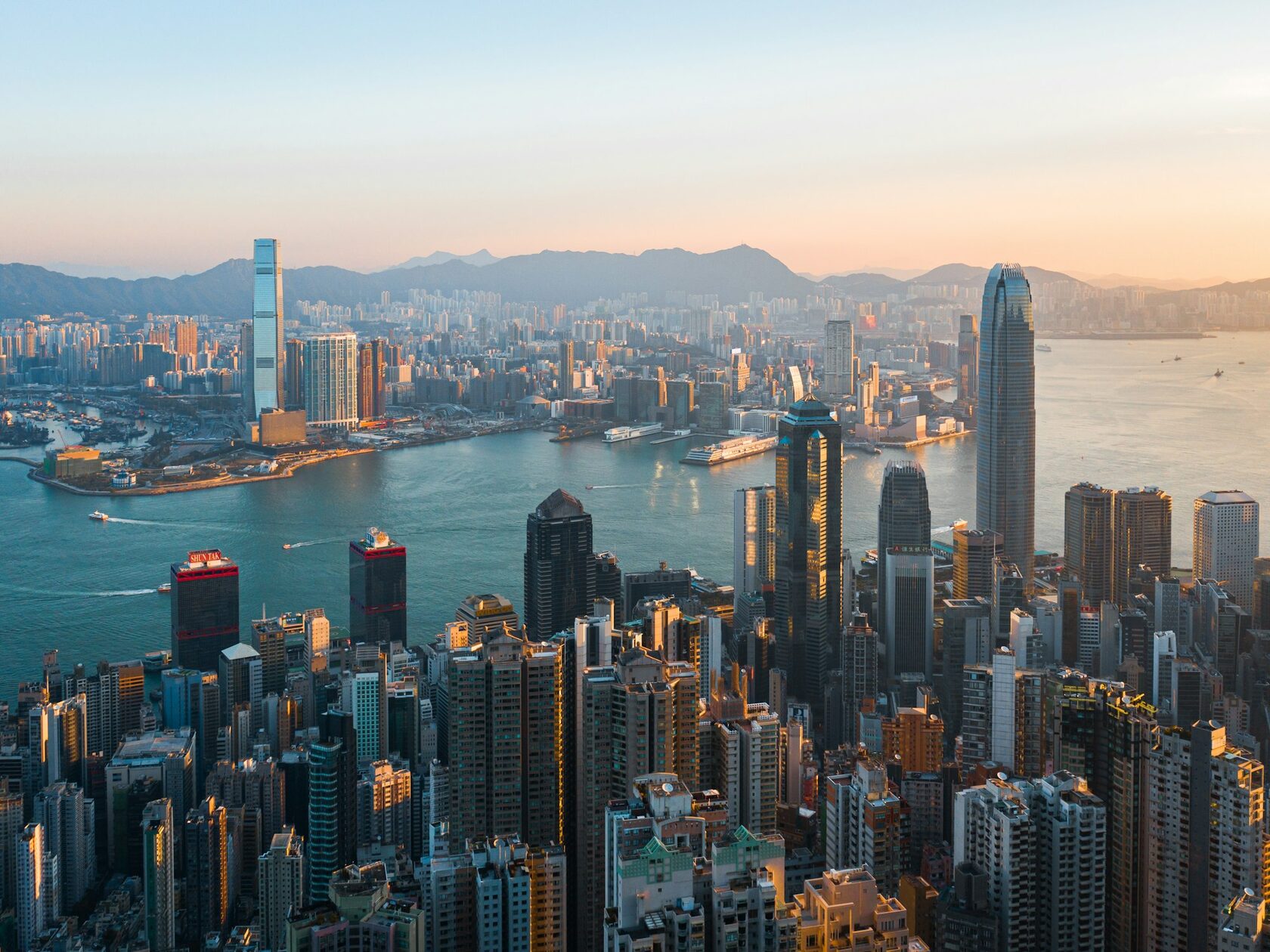
Residential towers and the record holder
The Kowloon peninsula is among the most densely built-up areas on the planet — with some neighbourhoods exceeding 100,000 residents per square kilometre. It was here, in 2010, that the ICC rose to its full height.
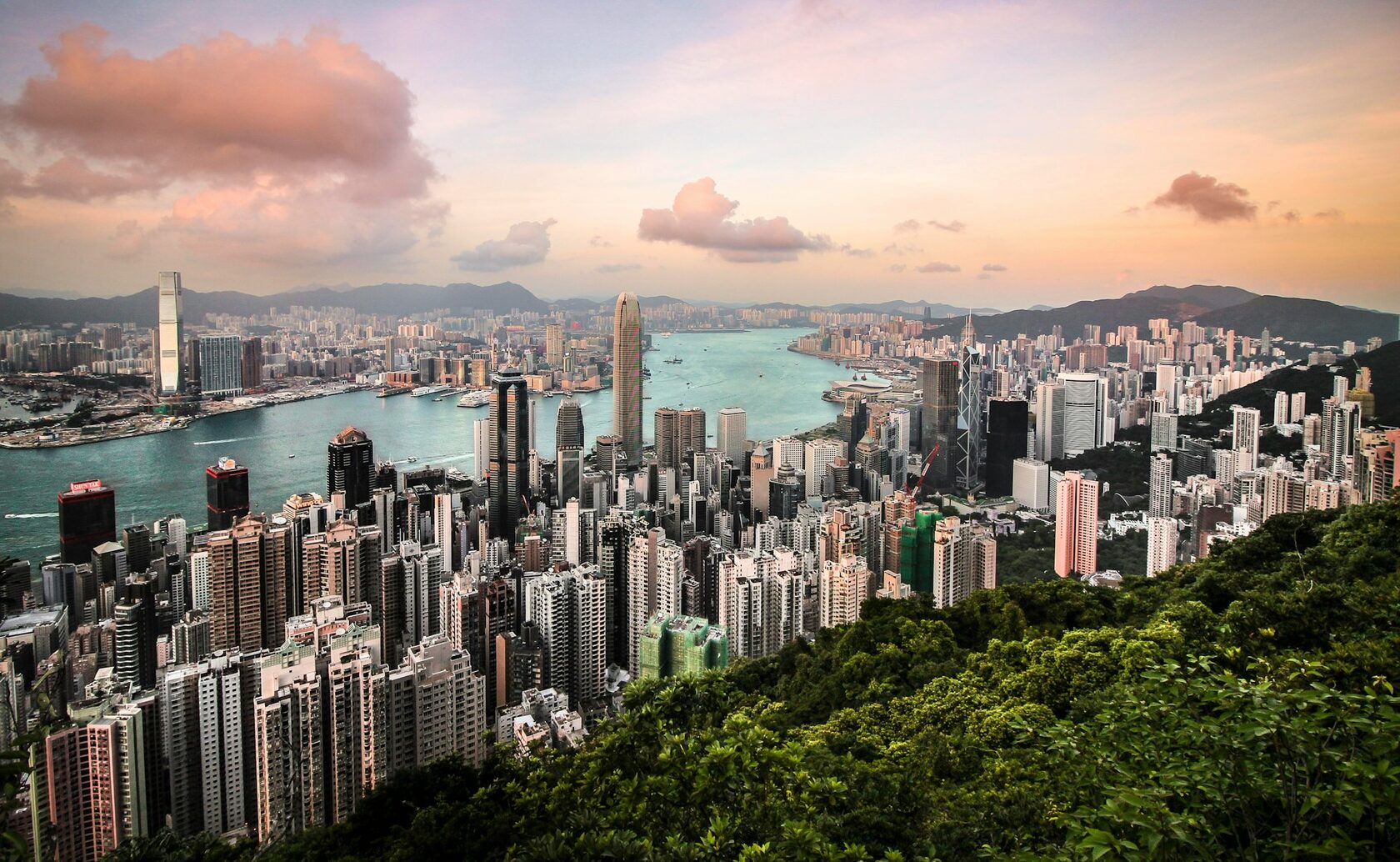
A growing cluster of commercial towers
Kwun Tong and Kowloon East are part of Kowloon, not the New Territories. The government has been deliberately developing East Kowloon as a second commercial cluster since the 2010s, with new Grade-A offices opening alongside industrial-flatted buildings being converted to commercial use.
Six of the most photographed and influential buildings in Hong Kong — from the record-holding ICC to the historic HSBC Main Building.
№ 1 · 367 m I. M. Pei · 1990 · A landmark of geometric structural expression
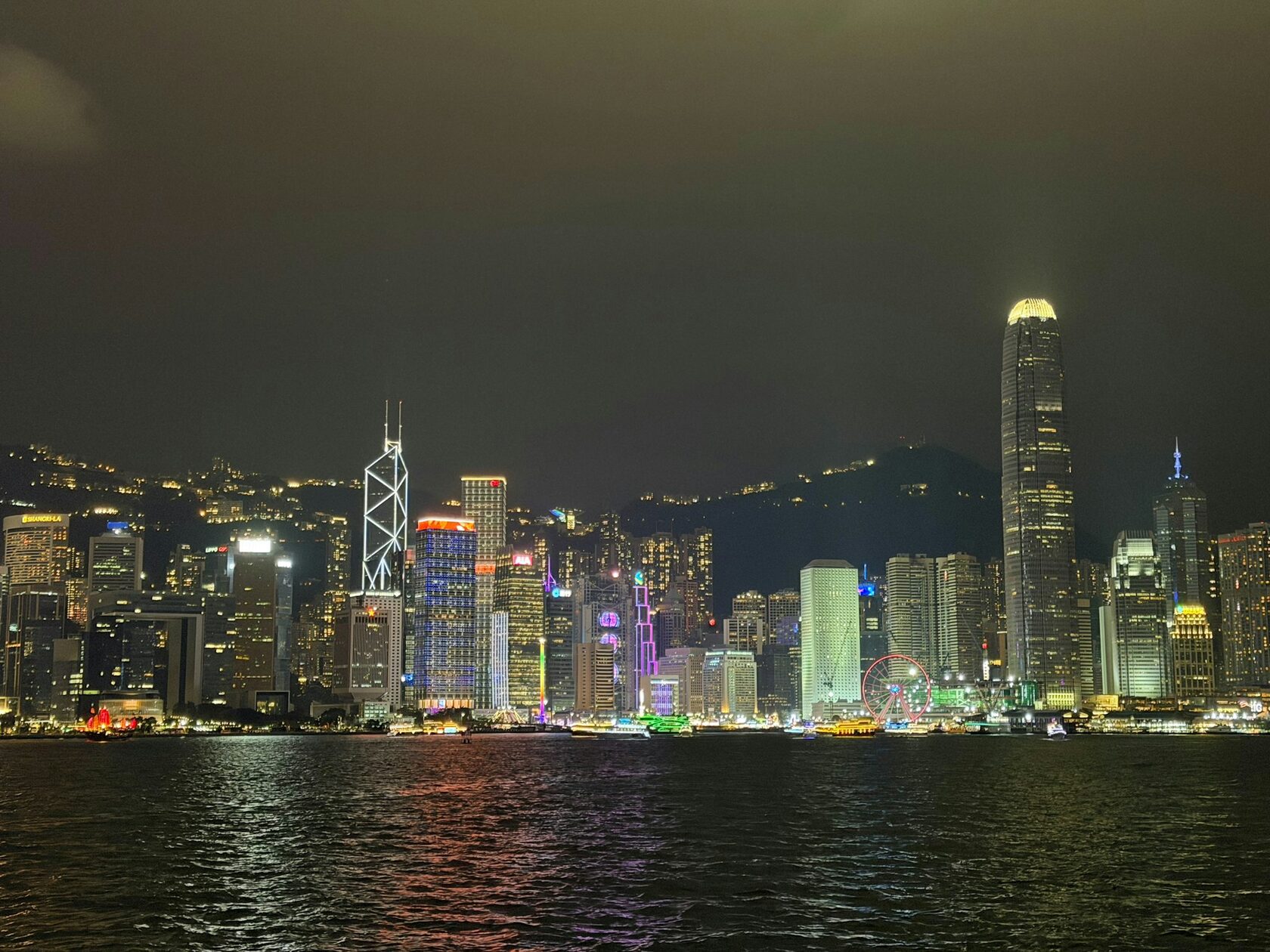
A 367 m tower by I. M. Pei defined by prismatic geometry, four vertical shafts and an innovative composite steel-and-concrete structural system. One of the first buildings in Asia to surpass the 300 m mark, the Bank of China Tower has been the city's defining silhouette since the 1990s.
View on mapHeight, floors, year: The Skyscraper Center · CVU.
 № 2 · 484 m
KPF · 2010 · Hong Kong's record holder
Hong Kong's tallest building. The upper floors hosted the Sky100 observation deck and The Ritz-Carlton Hong Kong. The tower is integrated with Kowloon Station, served by the Airport Express and the high-speed rail to mainland China.
View on mapHeight, floors, year: The Skyscraper Center · CVU.
№ 3 · 412 m César Pelli · 2003 · Wedge silhouette above the harbour
A 412 m wedge-shaped tower by César Pelli whose clean blade cuts into the sky above Victoria Harbour. Inside sit the offices of major financial services firms, the Hong Kong Monetary Authority (HKMA) headquarters and the Four Seasons hotel.
View on mapHeight, floors, year: The Skyscraper Center · CVU.
 № 4 · 346 m
Dennis Lau & Ng Chun Man · 1998 · Programmable facade
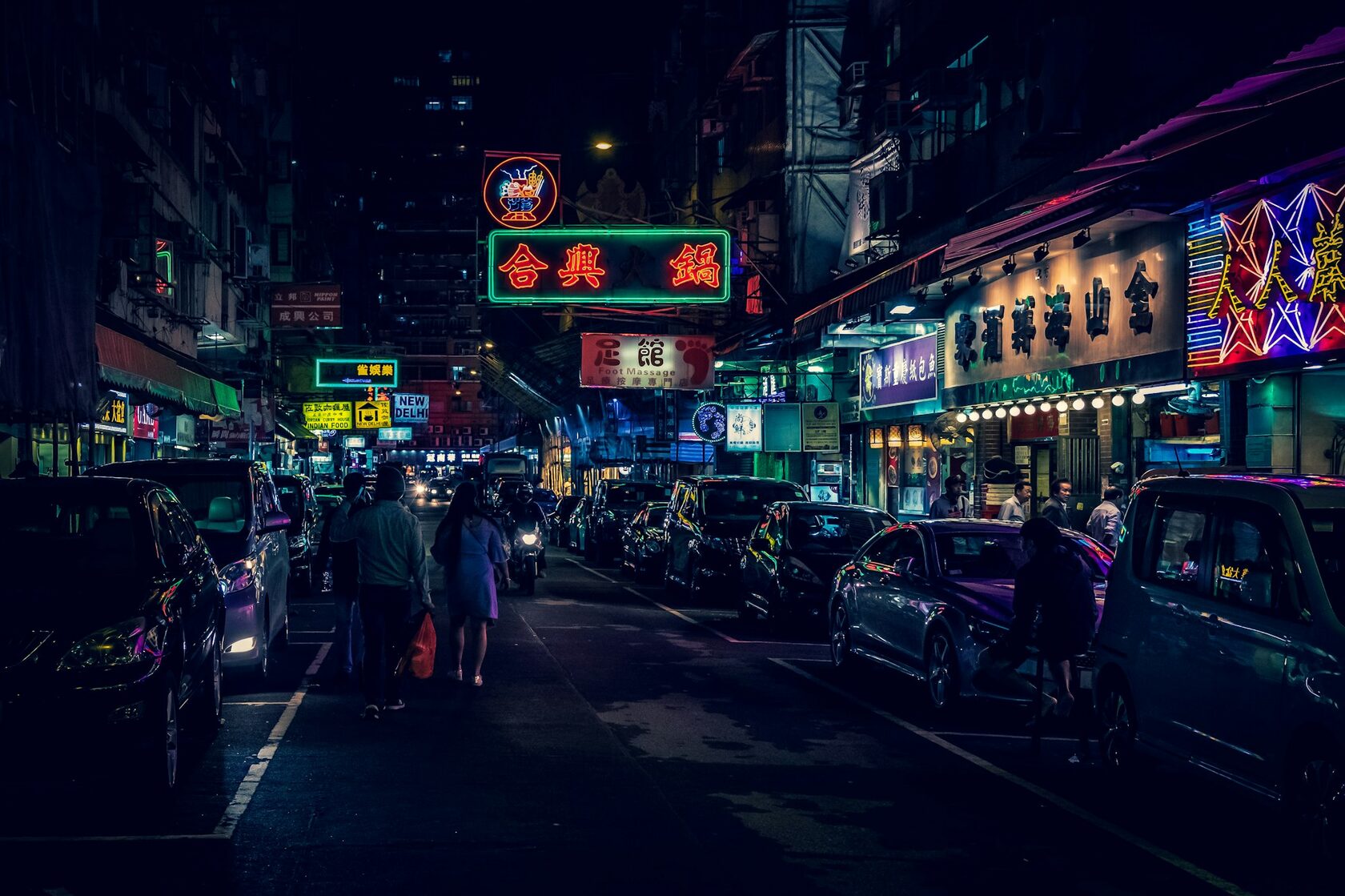
Hong Kong's most colourful skyscraper: by night its facade is animated by a programmable LED installation visible for kilometres. It is widely cited as one of the largest building-mounted LED displays in the world.
View on mapHeight, floors, year: The Skyscraper Center · CVU.
 № 5 · 393 m
Located on the 100th floor of ICC · Opened 2011
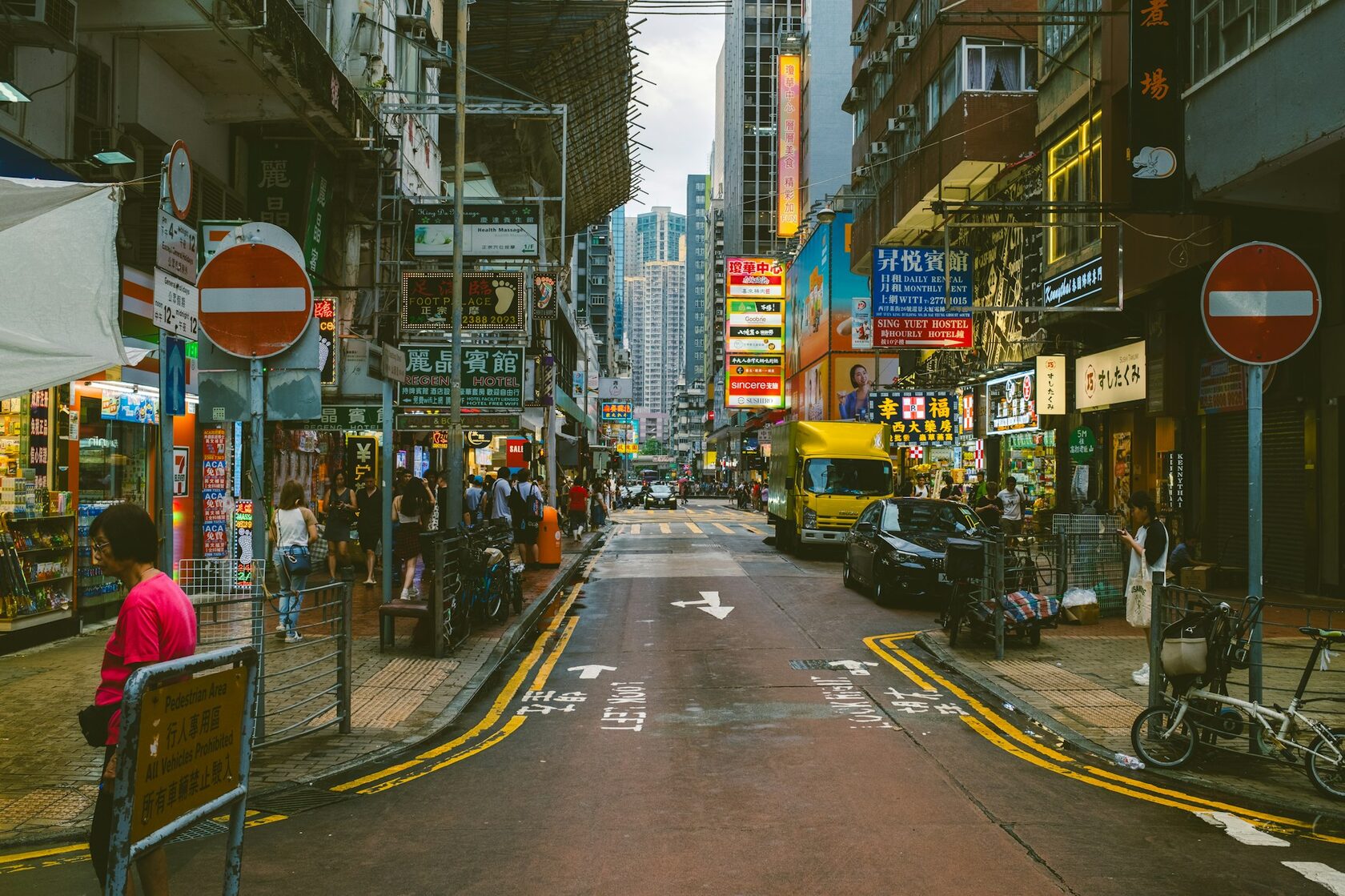
An observation deck on the 100th floor of the ICC. The 360-degree view sweeps across Kowloon, Central, Victoria Peak and, on clear days, the islands of Lantau and the mainland China coast. Sky100 is currently undergoing a major renovation; reopening details have not yet been announced — check the official operator before planning a visit.
Status: Sky100 official operator.
 № 6 · 374 m
Ng Chun Man · 1992 · Diamond silhouette
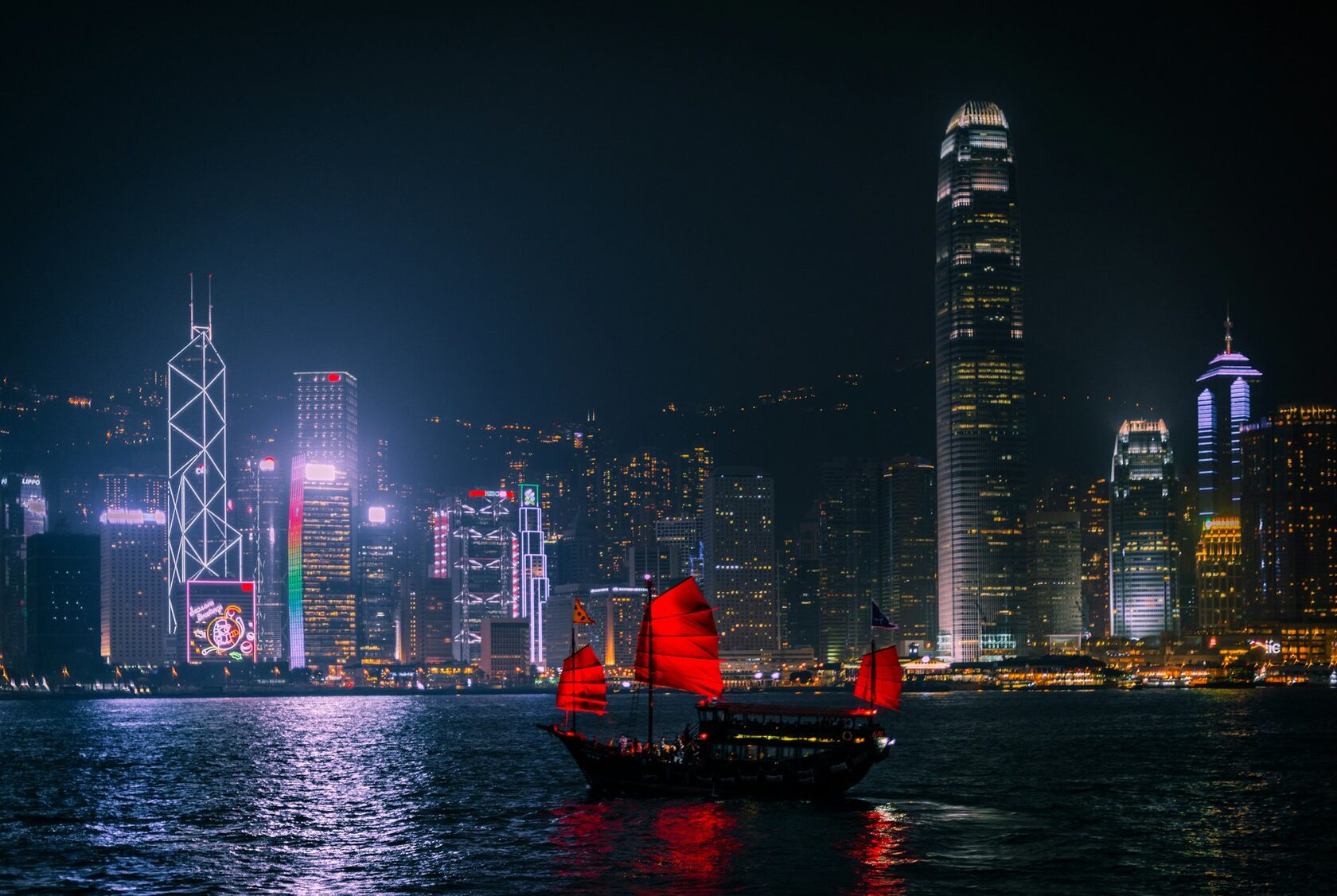
One of Hong Kong's most photogenic towers, with a facade shaped from three isosceles triangles. At its crown sits a four-sided clock, its neon illumination shifting colour through the evening.
View on mapHeight, floors, year: The Skyscraper Center · CVU.
A reference of verified completed towers above 250 m, sorted by architectural height. Heights per CVU / The Skyscraper Center.
| # | Building | Height | Year | District | Architect |
|---|---|---|---|---|---|
| 01 | International Commerce Centre | 484 m | 2010 | West Kowloon | KPF |
| 02 | Two International Finance Centre | 412 m | 2003 | Central | César Pelli |
| 03 | Central Plaza | 374 m | 1992 | Wan Chai | Ng Chun Man |
| 04 | Bank of China Tower | 367 m | 1990 | Central | I. M. Pei |
| 05 | The Center | 346 m | 1998 | Central | Dennis Lau & Ng Chun Man |
| 06 | Nina Tower | 320 m | 2006 | Tsuen Wan | Wong & Ouyang |
| 07 | One Island East | 298 m | 2008 | Quarry Bay | Wong & Ouyang |
| 08 | Cheung Kong Centre | 283 m | 1999 | Central | César Pelli |
| 09 | The Masterpiece | 257 m | 2008 | Tsim Sha Tsui | Wong & Ouyang |
| 10 | Langham Place Office Tower | 255 m | 2004 | Mong Kok | Wong & Ouyang |
Selection of verified completed buildings above 250 m · Heights per The Skyscraper Center · CVU. The Masterpiece height of 257 m is from its building record. Heights shown are architectural. Reference date: end of 2025.
From the first trading houses on the waterfront to the forest of spires in the 2020s.
The island is seized by the British Empire after the First Opium War. Port-city infrastructure is laid down, oriented from the outset towards vertical development — the surrounding mountains leave little horizontal room to spare.
Ferry services across Victoria Harbour begin. The wooden boats give the young port city its first mass transit artery and set the pattern for the harbour-centric vertical development to come. The Star Ferry company itself is incorporated ten years later, in 1898.
The first truly tall building in Hong Kong — Jardine House at 179 m, 52 floors — rises over the harbour. Its round porthole windows become the calling card of the business district.
Norman Foster designs the HSBC Main Building at 180 m. It pioneers a suspended structure and a naturally lit atrium that would later define Foster's career. The genuine skyscraper boom is now underway, accelerated by land scarcity and Hong Kong's growing role as Asia's financial hub.
I. M. Pei's 367 m tower introduces prismatic geometry — four vertical shafts and diagonal structural members that frame an innovative composite steel-and-concrete system. Overnight Hong Kong becomes the world capital of geometric structural expression. The tower becomes the city's defining silhouette — it appears in logos, postcards and tourist brochures.
On 1 July 1997 Hong Kong is officially returned to China. Despite the political transition, skyscraper construction never pauses for a day. Instead of an expected capital flight, the city rides a boom — its status as the "gateway to China" gives it a new economic role.
César Pelli's 412 m blade is completed. The Victoria Harbour silhouette takes on its modern form.
The International Commerce Centre rises over the Kowloon peninsula. Hong Kong sets a new altitude benchmark — the city's first building over 450 m. ICC has held the Hong Kong record for fifteen years now.
Henderson Land welcomed the first tenants into The Henderson on 7 June 2024, according to the developer's official communications. Architectural height per CVU: 182.5 m; Henderson Land describes the development as a 190-metre-tall building.
Source: Henderson Land press release. Height: The Skyscraper Center · CVU.
Hong Kong surpassed 100 completed buildings of 200 metres or taller in 2025, joining Dubai, Shenzhen and New York among the four cities to have crossed that threshold by the end of 2025. The number of cities above 100 completed 200 m+ buildings increased from two to four in 2025.
Source: Council on Vertical Urbanism (CVU; formerly CTBUH) · 2026 Trends & Forecasts.
Every tall Hong Kong tower is an engineering answer to the South China Sea, which sends typhoons across the city several times each year.
A tuned mass damper is a heavy counterweight suspended high in the structure that swings in opposition to the building's motion during wind gusts and typhoons, reducing sway. In Hong Kong's tallest towers the mechanism is typically described in the developer's engineering documentation rather than in public datasheets.
All towers over 300 m are designed with aerodynamic "slots" or tapering profiles in plan. In the Bank of China Tower the diagonal structural members are not decoration — they form a structural frame that diverts vortex flows and reduces lateral wind load.
Major projects are tested in the wind tunnel at Hong Kong Polytechnic University. A scaled model is exposed to hundreds of wind directions, simulating typhoons and seasonal monsoons.
Hong Kong's tallest towers rest on large-diameter bored piles driven through reclaimed land and marine mud into the bedrock below. Pile lengths and diameters are project-specific and detailed in each developer's engineering report.
Express lifts in Hong Kong's tallest towers — including double-deck lifts serving sky-lobbies at intermediate floors — keep vertical circulation efficient at heights where a single lift shaft cannot service every floor.
Every evening at 8:00 pm, a coordinated sound-and-light show spans buildings on both sides of Victoria Harbour. It was listed in the Guinness Book of Records.
"A Symphony of Lights" began in 2004 and spans buildings on both sides of Victoria Harbour. Buildings are illuminated by LED modules synchronised to a musical score broadcast by FM radio stations in several languages. The show was listed in the Guinness Book of Records as the "World's Largest Permanent Light and Sound Show".
The show lasts around ten minutes. Among the best viewing points is the Tsim Sha Tsui promenade on the Kowloon side. Performances can be suspended under specified severe-weather warnings or emergency circumstances.
Hong Kong became one of the world's largest manufacturers of neon tubes in the 1950s and 1960s, when local workshops exported hand-bent signage across Southeast Asia. Through those decades, the streets of Tsim Sha Tsui, Wan Chai and Yau Ma Tei became an open-air gallery of light: every restaurant, every tailor, every herbalist and every fortune-teller had a sign.
The turning point came in the 1990s. Major office towers introduced programmable facades-of-light, treating whole buildings as media surfaces. The Center (1998) became famous for its animated LED facade; two decades later, the Symphony of Lights (2004) brought the harbour's towers into a single orchestrated show. From 2010 onward, energy-efficiency ordinances and the spread of cheaper LED and acrylic reproductions began to phase out physical neon from many historic streetscapes. Specialist studies offer varying counts of peak signage and surviving workshops — the era is best understood as one of cultural transformation rather than precise accounting.
Yet the city's appetite for light has not diminished — it has scaled. New projects such as AIRSIDE (2023) embed light into the architecture itself: kinetic facades, LED-lined sky gardens, programmable displays that change with the time of day. Hong Kong has not lost its neon — it has migrated the neon code from the street to the tower.
Hong Kong has been ranked among the world's least affordable housing markets for more than a decade. Figures below are illustrative ranges and should be verified against the Rating and Valuation Department and major agency reports before publication.
Hong Kong is one of the most public-transport-led megacities on Earth — the share of daily trips taken by metro, bus, tram or ferry is consistently among the highest in the world.

Hong Kong's metro is one of the busiest and most profitable systems in the world.

The legendary double-deck trams, in service since 1904. The route runs along the northern shore of Hong Kong Island.

A dedicated line from Central and Kowloon Station to Chek Lap Kok airport. The Guangzhou–Shenzhen–Hong Kong Express Rail Link connects Hong Kong to the mainland high-speed network.

Historic ferries between Tsim Sha Tsui and Central / Wan Chai. Operating since 1888 and still one of the city's leading attractions.
Source: Hong Kong Transport Department — about 90% of daily passenger journeys are made on public transport.

In Hong Kong, designers consult a feng shui master on many major projects. The Bank of China Tower is a widely discussed example; lifts in some buildings skip floors considered inauspicious. Whether or not one accepts the practice, it is part of how the city's towers are planned.

Hong Kong ranks first worldwide by number of completed 150 m+ buildings, according to The Skyscraper Center. Architects designing within the central business district routinely work with neighbours in close proximity and share common foundations.
At night Hong Kong becomes a city of light. Spires and facades glow with LED systems synchronised for "A Symphony of Lights" — the show spans both sides of the harbour and was listed in the Guinness Book of Records.

Wind and typhoons from the South China Sea dictate every tall design: aerodynamic profiles, open "ventilation slots" at the 200–300 m level, tuned mass dampers in the upper floors.

Hong Kong towers are cities inside a single building: offices, hotels, retail, metro, sky-walks, observation decks. The ICC integrates Kowloon Station, a shopping mall and the Airport Express. 2IFC links directly to Hong Kong Station and the IFC Mall.

Since the 2010s green roofs and sky gardens have become more common in Hong Kong. New towers target BEAM Plus, LEED or BREEAM certification; Hong Kong has committed to carbon neutrality by 2050. AIRSIDE is a documented multi-certification example (see below).
Hong Kong is one of Asia's most active markets for certified green buildings — a deliberate response to extreme density, humid subtropical climate, and a 2050 carbon-neutrality target.
Hong Kong's own certification system, run by the Hong Kong Green Building Council. Tailored to the city's subtropical climate and dense urban context, BEAM Plus is the primary rating for new commercial towers and is increasingly a baseline expectation in Grade-A office procurement.
International certifications also feature strongly. Major multinational tenants typically require LEED at Gold or Platinum level, and BREEAM In-Use ratings are common for retrofitted office stock.
Beyond certifications, Hong Kong's newest towers — including AIRSIDE and The Henderson — integrate sky terraces, planted facades and natural ventilation. These features are increasingly framed as essential rather than decorative in the city's high-density context.
Hong Kong has committed to carbon neutrality by 2050. Tall-building energy use, embodied carbon in concrete, and tenant fit-outs are now central to procurement. CVU regularly lists Hong Kong among Asia's leading "green vertical cities".
Snøhetta · Nan Fung · 207.1 m · Completed 2022 · Soft-opened 2023
A 47-storey commercial tower at Kai Tak with offices, retail and public space, designed around BEAM Plus, LEED and WELL targets simultaneously.
Source: The Skyscraper Center · CVU; Hong Kong Green Building Council; Nan Fung · AIRSIDE.
Hong Kong ranks first worldwide by number of completed 150 m+ buildings, according to The Skyscraper Center. In 2025 Hong Kong surpassed 100 completed buildings of 200 metres or taller, joining Dubai, Shenzhen and New York among the four cities to have crossed that threshold by the end of 2025.
Hong Kong has been ranked the world's least affordable housing market for more than a decade. That is precisely why the city builds up: on a lot that fits 20 storeys in Manhattan, Hong Kong fits far more.
Every evening at 8:00 pm, "A Symphony of Lights" runs across the harbour — listed in the Guinness Book of Records. Free to watch from the Tsim Sha Tsui promenade. Performances can be suspended under specified severe-weather warnings or emergency circumstances.
Hong Kong's tallest towers are maintained by specialist rope-access teams who work the glazing units, window washing rigs and lighting systems from dawn to dusk — a working skyline above the harbour every day of the year.
Hong Kong's tallest towers use express lifts and sky-lobby systems to move large volumes of people between floors at heights where a single shaft cannot service every floor.
In many Hong Kong buildings, lift buttons skip floors considered inauspicious in local tradition — most commonly 4, 14 and 24.
Hong Kong ranks first worldwide by number of completed 150 m+ buildings, with New York, Tokyo and Dubai close behind. Where Manhattan grew upward, Hong Kong grew into the deep sky above a narrow coastal strip around Victoria Harbour.
Record-high property prices have produced a market in 5–10 m² flats and partitioned subdivided units. The phenomenon has deep historical roots and is well-documented in academic and government studies.
About 90% of daily passenger journeys in Hong Kong are made on public transport — among the highest shares of any major city on Earth, and a structural advantage for the tall vertical city. Source: Hong Kong Transport Department.
Click on a marker — get the architectural profile, height and role of each building in the city's skyline.
Schematic — not to scale. Building positions are approximate and intended to illustrate the harbour layout only.
Hong Kong is widely cited as one of the world's most important financial centres, anchored by the Hong Kong Monetary Authority, the Hong Kong Exchange and the largest concentration of regional bank headquarters outside Singapore and Tokyo.
Hong Kong's flagship stock index. The index includes major Hong Kong-listed companies across finance, property, utilities and technology. Constituents and historical highs are published by Hang Seng Indexes Company.
Hong Kong Exchanges and Clearing is one of the largest exchanges in Asia by market capitalisation. It has allowed listings of companies with weighted voting rights (WVR) since 2018.
The Hong Kong dollar (HKD) is pegged to the US dollar within a band. Notes are issued by three issuing banks. Hong Kong is one of the world's leading offshore RMB centres.
Hong Kong is a significant centre for aviation and marine insurance. Its port is among the world's busiest container terminals.
A comparison with the world's other "vertical" capitals on key indicators of tall-building development.
| Indicator | Hong Kong | New York | Tokyo | Dubai | Shanghai |
|---|---|---|---|---|---|
| Buildings over 200 m | 100+ as of end of 2025 (CVU) | see The Skyscraper Center | see The Skyscraper Center | see The Skyscraper Center | see The Skyscraper Center |
| Tallest building | ICC · 484 m | One World Trade · 541 m | Tokyo Torch Toranomon Hills · ~255 m | Burj Khalifa · 828 m | Shanghai Tower · 632 m |
| Rank by 150 m+ buildings | #1 worldwide | see The Skyscraper Center | see The Skyscraper Center | see The Skyscraper Center | see The Skyscraper Center |
| City area | 1,114.57 km² | 783 km² | 2,194 km² | 4,114 km² | 6,340 km² |
| Population (end-2025) | 7.51 M | 8.3 M | 13.9 M | 3.5 M | 24.9 M |
| Dominant style | Prismatic structural expression | Art Deco · modern | Minimalism · hi-tech | Futurism · super-tall | Neo-futurism |
Sources: Council on Vertical Urbanism (CVU; formerly CTBUH) · 2026 Trends & Forecasts; The Skyscraper Center · Hong Kong. Other city tall-building counts vary by source, year and methodology and are best confirmed against The Skyscraper Center's city pages. Heights shown are architectural. Reference date: end of 2025.
Hong Kong never stops building. By 2030 the Victoria Harbour skyline is expected to gain additional towers in the super-tall category.
Zaha Hadid Architects
A biophilic tower in Central. Henderson Land welcomed the first tenants on 7 June 2024, according to the developer's official communications. Architectural height per CVU: 182.5 m; Henderson Land describes the development as a 190-metre-tall building.
Sources: Henderson Land press release; The Skyscraper Center · CVU; Henderson Land · The Henderson.
New World Development · low-rise complex
A retail-and-office complex adjacent to Hong Kong International Airport, part of the SkyCity development. The overall 11 SKIES complex is not a single supertall tower; its individual office buildings — including 11 SKIES Office Tower 1 at approximately 45.3 m / 9 floors, completed 2022, designed by Lead 8 — are low-rise. The complex is included here as an urban-development example rather than as a supertall.
Snøhetta · Nan Fung
Hong Kong's newest mixed-use tower at Kai Tak, designed around strong sustainability targets. Architectural height per CVU: 207.1 m; completed 2022 with soft-opening in Q3 2023. A 47-storey development with offices, retail and public space; Nan Fung describes it as a 200 m-high, 47-storey development.
Sources: The Skyscraper Center · CVU; Nan Fung · AIRSIDE; Hong Kong Green Building Council.
The names without whom Hong Kong's modern skyline would not exist — from Pei's prismatic Bank of China Tower to Foster + Partners' engineering-led solutions.
Bank of China Tower
In 1990 he completed the 367 m Bank of China Tower — a building that introduced prismatic geometry, four vertical shafts and an innovative composite steel-and-concrete structural system to Hong Kong. Pritzker Prize laureate 1983.
Two International Finance Centre
The author of 2IFC's wedge-shaped blade — the tower that became the canonical silhouette of Victoria Harbour.
HSBC Main Building
Creator of the "machine for a bank" — the HSBC Main Building (1985), still considered one of the most technologically advanced office buildings of the 20th century.
The Center · Central Plaza
A Hong Kong firm behind The Center and Central Plaza, two of the city's leading neon-and-glass high-rises.
The Henderson · Innovation Tower (PolyU)
The first woman to win the Pritzker Prize, she left Hong Kong two biophilic forms — the Innovation Tower at the Polytechnic University and The Henderson in Central.
International Commerce Centre · AIRSIDE (in collaboration)
An international skyscraper practice with a significant Hong Kong portfolio, including the city's record-holding ICC.
Each of Hong Kong's generations of skyscrapers has its own architectural language. Together they form the visual grammar of the vertical city.
Exposed trusses, suspended structures and a celebration of engineering. The era of "a building as a machine": services on the outside, daylight at the core. Jardine House (1973, ~179 m, 52 floors) introduced Hong Kong's first sky-lobby system; HSBC Main Building (1985, Foster, ~180 m) took the high-tech aesthetic to its world peak — a building held aloft by masts, with sunlight reaching the public plaza at ground level.
Geometry as sculpture: structure on the outside, not hidden. The Bank of China Tower (1990, I. M. Pei, 367 m) with its prismatic mass, four vertical shafts and diagonal structural members; Central Plaza (1992, Ng Chun Man, 374 m) with its triangular silhouette.
A return to clean geometry, but enriched by ornament, light and a new generation of materials. The Center (1998, Dennis Lau & Ng Chun Man, 346 m) is animated by a programmable LED facade. Cheung Kong Centre (1999, César Pelli, ~283 m) reintroduces the proportions of classical architecture to the modern tower.
The era of super-tall: wedge profiles, tapered tops, biomorphic curves. Architects treat the tower as a single aerodynamic object rather than a stacked grid. Two IFC (2003, Pelli, 412 m) is a clean wedge above the harbour; ICC (2010, KPF, 484 m) tapers smoothly to its spire.
Towers that breathe. Living facades, public sky gardens, planted terraces, natural ventilation at the upper levels. AIRSIDE (2023, Snøhetta, 207.1 m) at Kai Tak is a 47-storey commercial building; The Henderson (opened June 2024, Zaha Hadid Architects, 182.5 m) is sculpted around four-sided sky terraces. Carbon neutrality by 2050 is a planning target.
Subtropical climate, high humidity, typhoons from May to October. Hong Kong's architecture is engineered precisely for these conditions.
Average temperatures in Hong Kong range from about 16 °C in January to about 29 °C in July, with an annual mean of roughly 23 °C. Hong Kong Observatory normals for 1991–2020 report an annual rainfall of 2,431.2 mm and an average of 139.9 days per year with rainfall ≥ 0.1 mm.
This page is built around a small set of authoritative sources: the Council on Vertical Urbanism (CVU; formerly CTBUH) and The Skyscraper Center, Hong Kong government agencies, and the official developer or architect pages for each named project.
Building heights follow Council on Vertical Urbanism (CVU) architectural-height criteria unless otherwise stated. Construction status and completion dates are drawn from CVU / The Skyscraper Center, official developers, and Hong Kong government sources. City statistics include their relevant reference date.
Continue exploring the vertical cities catalog — each with its own signature on the tall-building map.